I have confidence in sunshine,
I have confidence in rain.
I have confidence that spring will come again!
Besides which, you see, I have confidence in me!
When I was teaching, my students used to get a kick out of the fact that every once in a while I would break into song.
One of my favorites was I Have Confidence from The Sound of Music.
I’ve been thinking about that song lately. I’ve also been thinking about confidence, trust, and résumés.
A résumé can list what I’ve done. It can remind me of exhibitions, teaching, projects, and accomplishments. But confidence doesn’t come from a list of what I’ve already done.
It comes from trusting what I can do next.
I’ve been working on a new series of small drawings and paintings, and I’m pleased to say that some of them will be going to New York in December for Collective Z’s Small Works show.
I’m excited to be showing with Collective Z again. It’s a wonderful small gallery, and I’ve really enjoyed working with Alex Z. Wang.
Will every piece I make be the best piece I’ve ever made? Probably not.
That’s not really the point.
Whatever comes out of that process, it will be the best of me.
Bill Hendricks
Three works in progress from the Small Works series, 2026. Pen and ink on paper.
Collective Z is a contemporary gallery and project space on Broome Street in New York, dedicated to artists working in states of transition, tension, and becoming.
I find myself reminiscing about the past more often these days.
I think about Christopher Street and the wonderful life that was lived there. I think about the friends I made, and the friends who became family, during one of the most intense periods in LGBTQ+ history—the AIDS epidemic.
So many of those friends are gone now.
But I still think about them. I remember them. And I think about the wonderful life I have had, and the life I am still having, and how much fun it would have been to share some of this life with them.
Maybe that has something to do with how Marsha P. came into being.
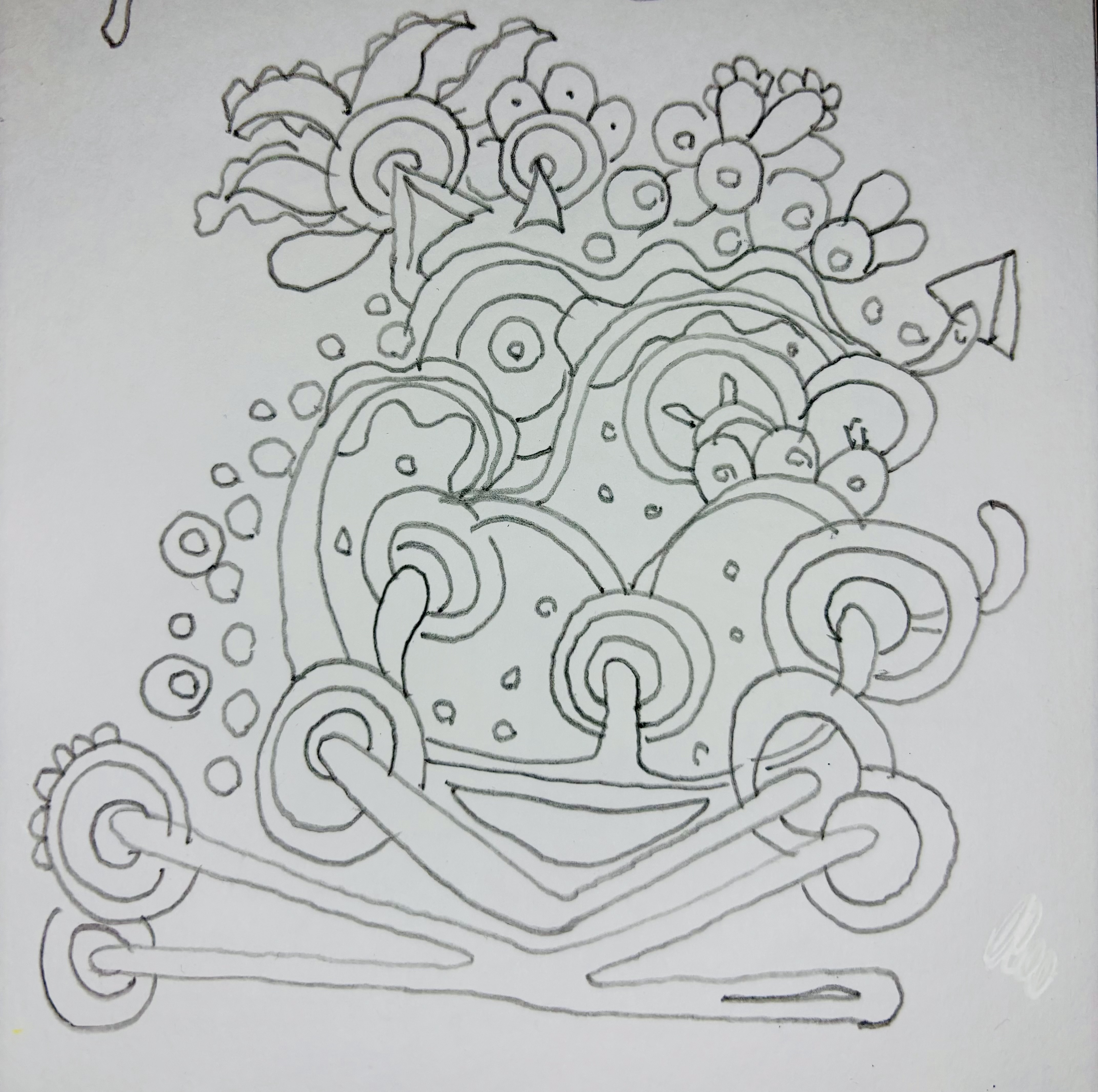
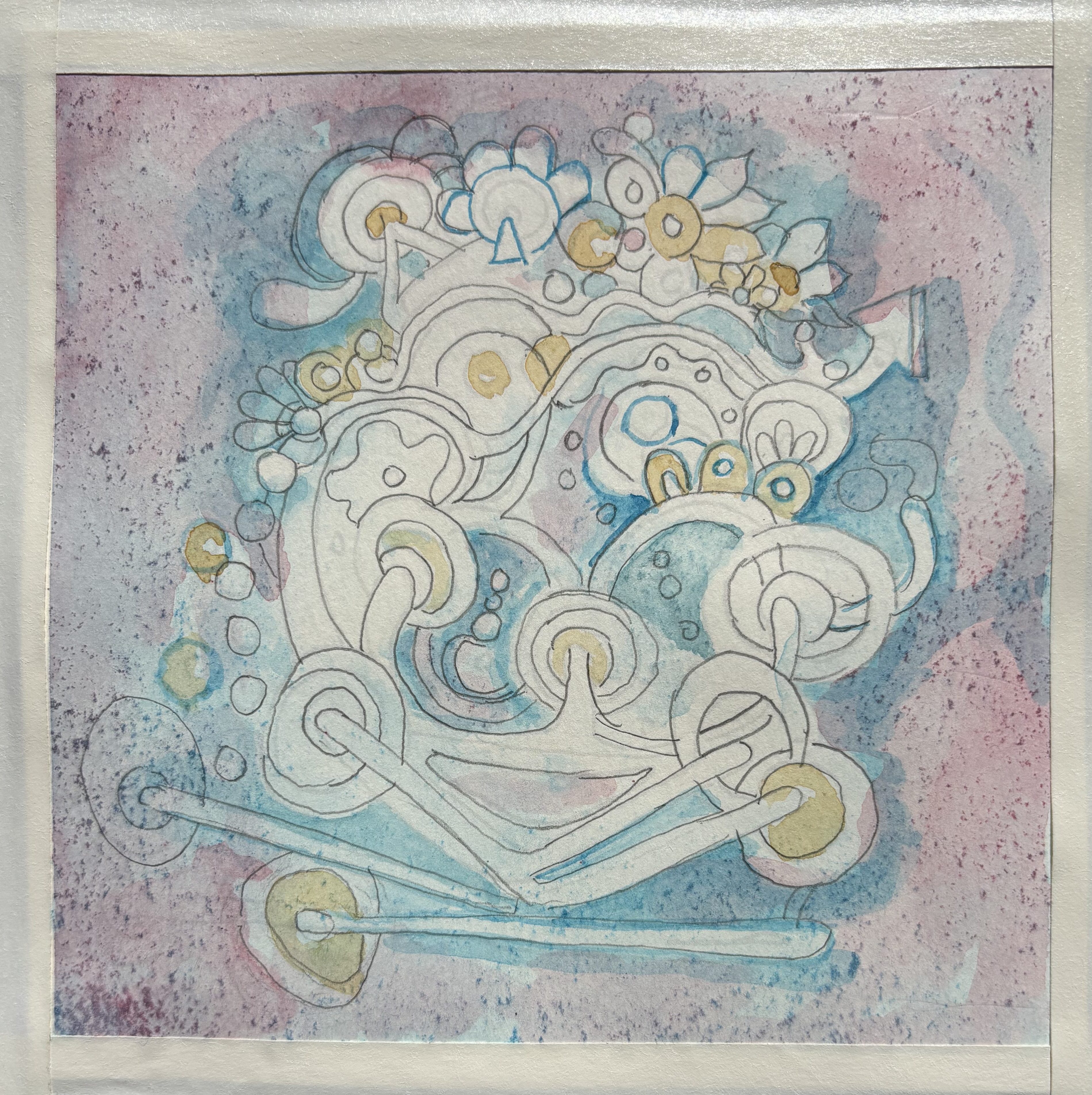
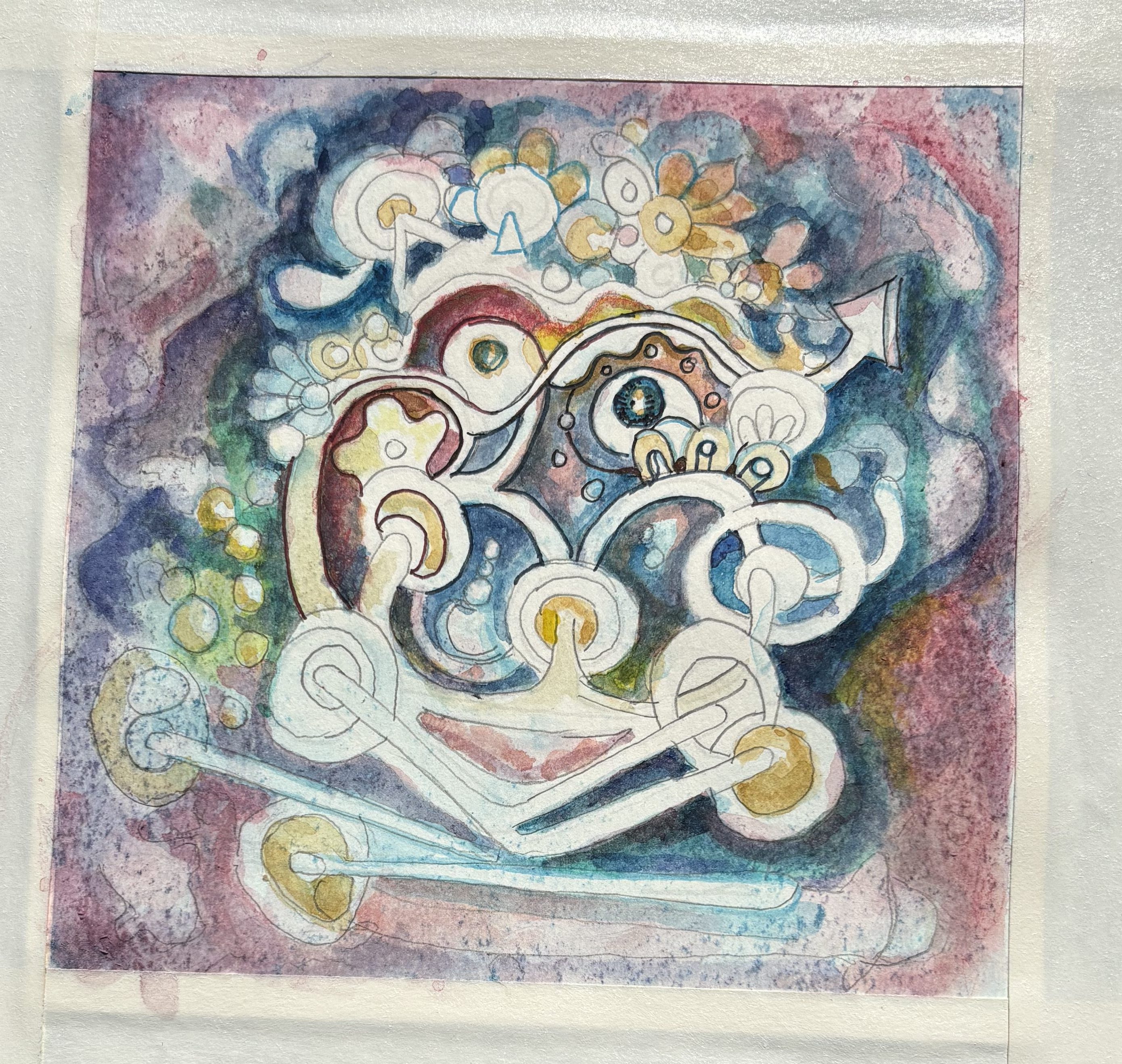
The original abstract drawing—the first stage of what became Marsha P.An early stage, as I explored tinting beneath the drawing and bringing areas back.A middle stage of the drawing, as the eyes, smile, and surrounding colors became more defined.Marsha P. — finished mixed-media drawing by Bill Hendricks, 2025.
The drawing did not begin as Marsha P. Johnson.
I know that.
It began as a very abstract sort of image. I was working with shapes and lines without any intention of making a portrait.
Then I began to see something.
First I saw the smile.
At this point, I was exploring how to tint underneath the drawing—putting color down and then bringing areas back.
As I worked, I began to see the eyes.
And all along there was a certain joy in the drawing that kept coming through.
I continued drawing, painting, changing things, covering things, uncovering things. The more I worked, the more something from my own history seemed to be coming forward.
My past became present.
Marsha was part of the world I remember.
I don’t mean that Marsha and I were close friends. We weren’t.
She was someone who passed through my life.
But she was a character on Christopher Street, just as I was a character on Christopher Street—working in a gallery among lots of other characters I loved dearly.
There was something about seeing her emerge from this drawing that gave me a way of becoming involved with that world again.
Not simply remembering it.
Participating in it.
For a little while, the distance between then and now became smaller.
The finished work became Marsha P.
For me, it carries more than the image of one person. It carries something of Christopher Street, of friendship, of loss, of survival, and of the extraordinary joy that existed alongside some very difficult years.
Maybe that is why the joy in the drawing matters so much to me.
The work later traveled to New York, where it was exhibited during Pride Month. The original Marsha P. is now available through Collective Z Gallery on Artsy.
But when I look at it, that isn’t what I think about first.
I think about the people.
I think about the life we lived.
Sometimes, while making a drawing, the past finds its way back into the room.
Currently at Collective Z
Collective Z is currently presenting Second Nature, bringing together painters Gwen Yip and Spencer Patrick. Their work considers the spaces New Yorkers move through—from the public world of subway platforms to the private interiors where people retreat.
Second Nature is on view through August 29, 2026, at Collective Z, 325 Broome Street, New York.
The former home of TR’s Gallery at 51st Street and Seventh Avenue. Today it’s a souvenir shop, but it still holds an important place in my story.
We never know the part we’ve played in another person’s life. — Bill Hendricks
Carolyn Solomon, where are you?
It’s a strange question to ask someone I haven’t seen in more than forty years.
A few weeks ago, while I was back for The Ordinary at Collective Z Gallery, I walked over to the building that once housed TR’s Gallery. I managed that gallery for Circle Fine Art in the mid-1980s. Today the space is a souvenir shop.
Standing there, I found myself thinking about you.
You may not remember me. I was one of many gallery managers. But you gave me an opportunity that mattered.
A bonus I earned while managing TR’s Gallery helped Michael and me start Desired Printing. Looking back now, I can trace a line from those years in New York, to teaching, and finally back to the studio.
When I returned home, I began looking for you. I learned that Jack Solomon had passed away. My condolences. He was always kind to me. I wasn’t able to learn much more about you.
This isn’t a letter expecting an answer.
It’s a thank you.
We never know the part we’ve played in another person’s life.
Looking back, I can see that you played a part in mine.
Bill Hendricks, Kaitlin Reid, and Michael Reid at The Ordinary, standing in front of Marsha P. at Collective Z Gallery in Manhattan, June 4, 2026.
My drawing, Marsha P., was recently included in The Ordinary, a Pride Month group exhibition at Collective Z Gallery in Manhattan.
I went to New York not knowing quite what to expect. It had been a long time since I had shown work in a setting like this, and I arrived with all the usual questions: How would the work look? How would people respond? Would I feel comfortable there?
What surprised me most was how interested I became in the other artists’ work. I arrived focused on my own piece, but quickly found myself drawn into the larger exhibition. The quality of the work impressed me, and I was proud to see Marsha P. holding its own among it.
There was another surprise.
Friends appeared. Some I had not seen in years. Others reached out online. Their support meant more to me than I expected.
Standing in the gallery, surrounded by artists, friends, and people engaging with the work, I felt something I hadn’t anticipated: a sense of belonging.
When I look back on the experience, I will remember the artwork, the conversations, and the people who showed up. But I will also remember realizing that, after many years, I still have something to contribute as an artist.
For that, I am grateful.
The Ordinary remains on view through the end of the month at Collective Z Gallery in Manhattan. Marsha P. is also available for purchase.
I am especially grateful to Alex Wang and Collective Z Gallery for creating the exhibition, bringing together such a diverse group of LGBTQ+ artists, and making space for these conversations.
Bastiano (Aristotle) da Sangallo (1481–1551), The Council Episode of the Battle of Cascina, after Michelangelo Buonarroti, 1542. This painting preserves part of Michelangelo’s lost composition for the unfinished Battle of CascinaThomas Hart Benton (1889–1975), Martha’s Vineyard.
I was at the Raphael exhibition at the Metropolitan Museum of Art, and I was not expecting much after being at the Vatican and in Rome and seeing so many of Raphael’s works in person. However, the show at the Met was a real eye-opener.
Not only did it present the history and the images, but it also showed Raphael’s education and the many works he studied and used as references for his own work. Specifically, I was enamored by his drawings. The drawings had real life.
What I realized is that as he tightened the renderings, the life gradually faded away. I know I am not in any position to critique Raphael’s work, but that was one of the most amazing things I took from the exhibition.
The other surprise was finding an image created by an artist copying Michelangelo’s work. When I saw it, it reminded me so much of Thomas Hart Benton: the energy, the rhythm, even the lighting and shading.
It revealed to me that Benton, too, must have been deeply drawn to Michelangelo’s frescoes and to the undulating, muscular compositions Michelangelo favored.
One of the things I enjoy most about museums is that you never know what is going to stay with you. I went to see Raphael. I left thinking about Michelangelo, Thomas Hart Benton, and the ways artists borrow from one another across generations. Sometimes the most memorable part of an exhibition is not what you came to see, but the unexpected connection you discover along the way.
“The drawings crackle with nervous energy, which gradually attenuates as Raphael translates spontaneous insights into the cool, lacquered surface of painting.” — Financial Times
That observation captured exactly what I felt walking through the exhibition.




 The Ordinary remains on view through the end of the month at Collective Z Gallery in Manhattan. Marsha P. is also available for purchase.
