In 1969, I remember hearing about Stonewall late one night on KDWB radio. They were interviewing Jack Baker.
I was sixteen years old.
For the first time, I realized there were others. I wasn’t alone.
Looking back now, I realize that moment wasn’t just about being gay. It was the beginning of a lifelong search for direction—for understanding how people find their place in the world and how we make sense of lives that don’t always fit the expected path.
I’ve spent much of my life looking for paths.
Sometimes those paths appeared as maps. Sometimes as diagrams. Sometimes as outlines, websites, or decision trees. Often they appeared simply as ways of organizing what I could see—and finding relationships among things that did not, at first, seem connected.
As a teacher, I spent years making outlines, building websites, drawing wireframes, and thinking in mind maps. I taught Gestalt theory—the idea that our minds naturally seek relationships and organize visual information into meaningful wholes.
Being dyslexic, I think I was already doing that long before I knew there was a name for it.
I’ve often described myself as someone who sees patterns. And I still believe that’s true.
But during one of my daily walks, another thought quietly surfaced.
Maybe what has fascinated me all these years hasn’t been patterns themselves.
Maybe it’s been finding my way.
Patterns are useful because they reveal possible paths. Maps matter because they help us navigate. Even a labyrinth has a pattern—but its purpose isn’t the pattern itself. Its purpose is to help us travel and find ourselves.
That realization feels surprisingly important.
When I look back over my life—from hearing Jack Baker on the radio… to teaching students how we make sense of the world… to designing websites… to creating art… to exploring identity, community, and spirit—I don’t see disconnected experiences anymore.
I see one long journey.
The maps changed.
The questions changed.
The medium changed.
But the journey remained remarkably consistent.
Lately I’ve started calling some of my drawings Decision Trees.
At first I thought they were simply abstract compositions.
Now I wonder if they’re visual journals.
They resemble the maps, outlines, webs, and structures I have used throughout my life—not because I planned them that way, but because they’ve always been part of how I think.
Related post: This reflection continues the ideas I began exploring in Looking Back, Looking Forward, where I considered how patterns can help us find our way.
Video:Looking Back, Looking Forward. A sequence of Bill Hendricks’s line drawings explores maps, branching paths, and emerging patterns. Music accompanies the images, along with a message.
Maps, patterns, and finding my way
During one of my daily walks, I realized something had been quietly growing over the past few weeks.
Looking back over my life, I see a thread I hadn’t fully recognized before.
As a teacher, I wasn’t really teaching maps. I was teaching how people think. Gestalt theory, visual relationships, organizing information, recognizing connections—those ideas found their way into almost everything I taught. Site maps, mind maps, color wheels, design systems… they were never just tools. They were ways of seeing.
Now I’m beginning to notice those same patterns emerging in my artwork.
The drawings began as what I called Decision Trees. Each branch suggested another possibility, another choice, another path.
But lately I’ve started wondering if they’re about something else.
Maybe they aren’t about making decisions.
Maybe they’re about recognizing patterns.
When life becomes uncertain, my instinct is to search for a new direction. Yet I’m beginning to wonder if the path is already there, waiting to be recognized. Perhaps finding our way isn’t about inventing something new. Perhaps it’s about noticing the connections that have been quietly leading us all along.
That thought has stayed with me.
It has even changed the way I look at these drawings. They no longer feel like illustrations of an idea. They feel like evidence of a conversation I’ve been having with myself without realizing it.
I don’t know exactly where this series is going.
That’s the exciting part.
For the first time in a while, I don’t feel like I’m forcing the work toward an answer. I’m simply paying attention to where it wants to lead.
Maybe that’s what artists do.
Maybe that’s what all of us do.
We keep looking back, not to live in the past, but to recognize the patterns that help us move forward.
“Humans are pattern-seeking, storytelling animals. We look for and find patterns in our world and in our lives.”
In order to experience a poem, we must understand it; in order to understand it; we must hear it, see it, contemplate it—convert it into an echo, a shadow, nothingness. Comprehension is a spiritual exercise.
Octavio Paz, Alternating Current, p. 49
wp-content/uploads/2021/03/
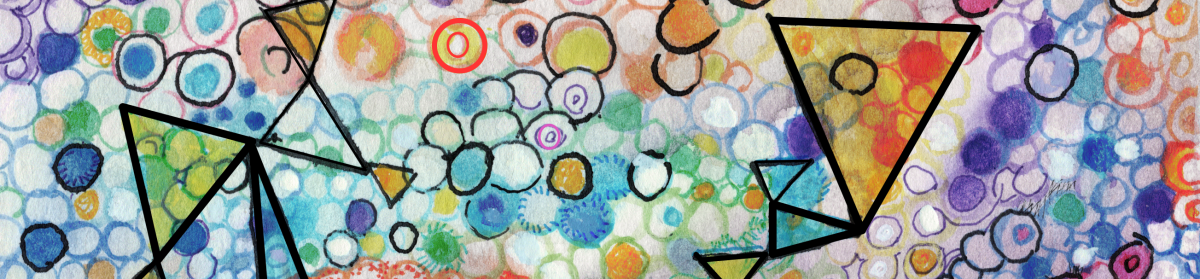
Floating through Space and Time, Mixed-media, Hendricks@2023
I don’t think I am creating anything as profound as Paz describes, but as I said many times in this blog—I am on a path, which is not totally visible to me. I get glimpses, but never too sure what I see. I do want to say that just because I post works of art, I do not think they are grand, that the technique is refined, or the lines sure and sharp. I know they are not. However, as I do and study my ideas, my voice and path will clarify. There is one thing I want readers and friends to know, and that is that I believe in a power greater than ourselves, and there is a piece, a bit, of that power, that Light within each of us. I don’t know if I am a theist, non-theist, pantheist, or panentheist. Whatever I am, I seek to reach, connect, and engage with that Light that exists within me… and you. I am saying this partly because I have avoided saying it in the public eye of art critics and peers. OH MY GOD! I just came out again. 😆