I have confidence in sunshine,
I have confidence in rain.
I have confidence that spring will come again!
Besides which, you see, I have confidence in me!
When I was teaching, my students used to get a kick out of the fact that every once in a while I would break into song.
One of my favorites was I Have Confidence from The Sound of Music.
I’ve been thinking about that song lately. I’ve also been thinking about confidence, trust, and résumés.
A résumé can list what I’ve done. It can remind me of exhibitions, teaching, projects, and accomplishments. But confidence doesn’t come from a list of what I’ve already done.
It comes from trusting what I can do next.
I’ve been working on a new series of small drawings and paintings, and I’m pleased to say that some of them will be going to New York in December for Collective Z’s Small Works show.
I’m excited to be showing with Collective Z again. It’s a wonderful small gallery, and I’ve really enjoyed working with Alex Z. Wang.
Will every piece I make be the best piece I’ve ever made? Probably not.
That’s not really the point.
Whatever comes out of that process, it will be the best of me.
Bill Hendricks
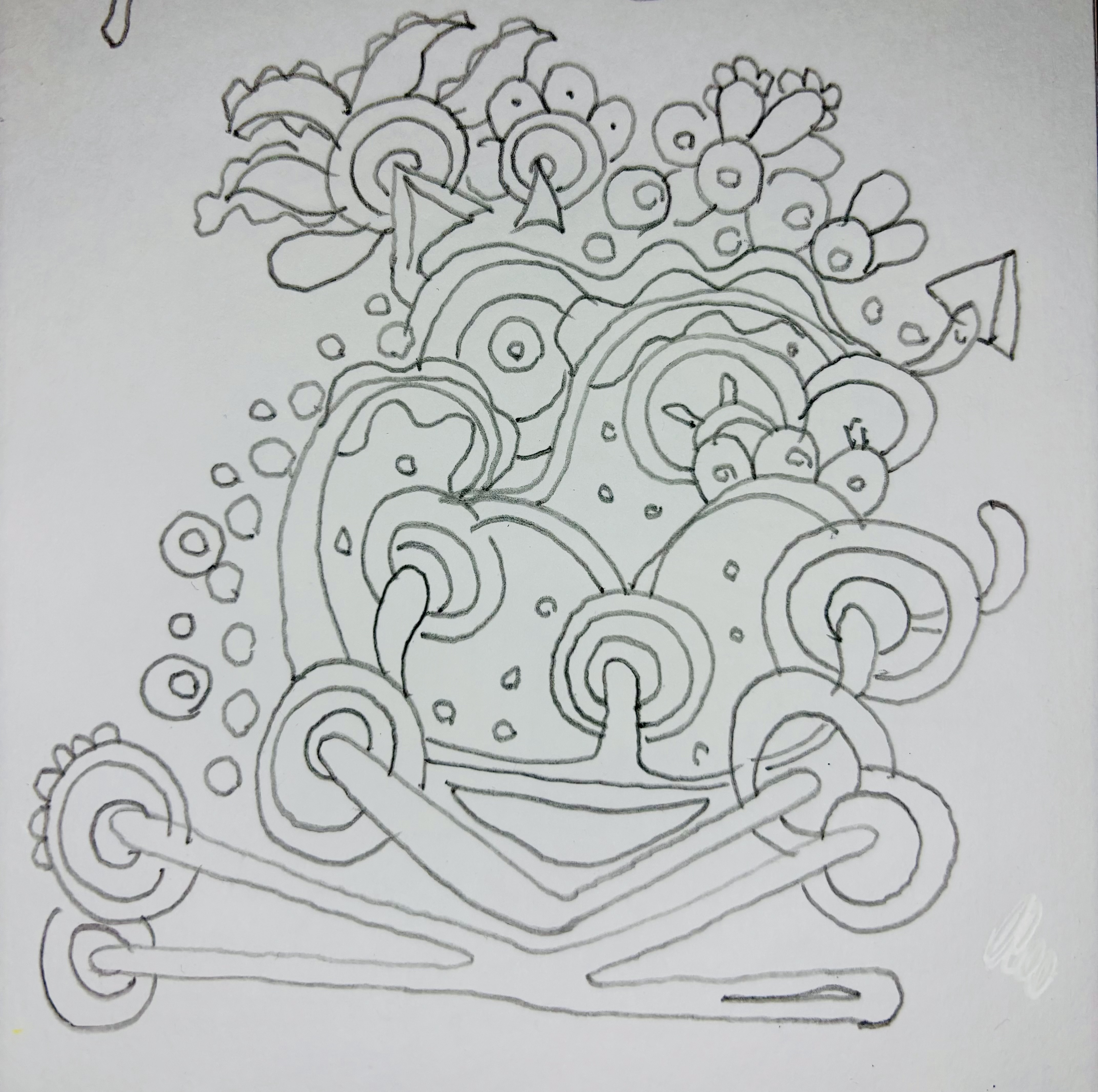
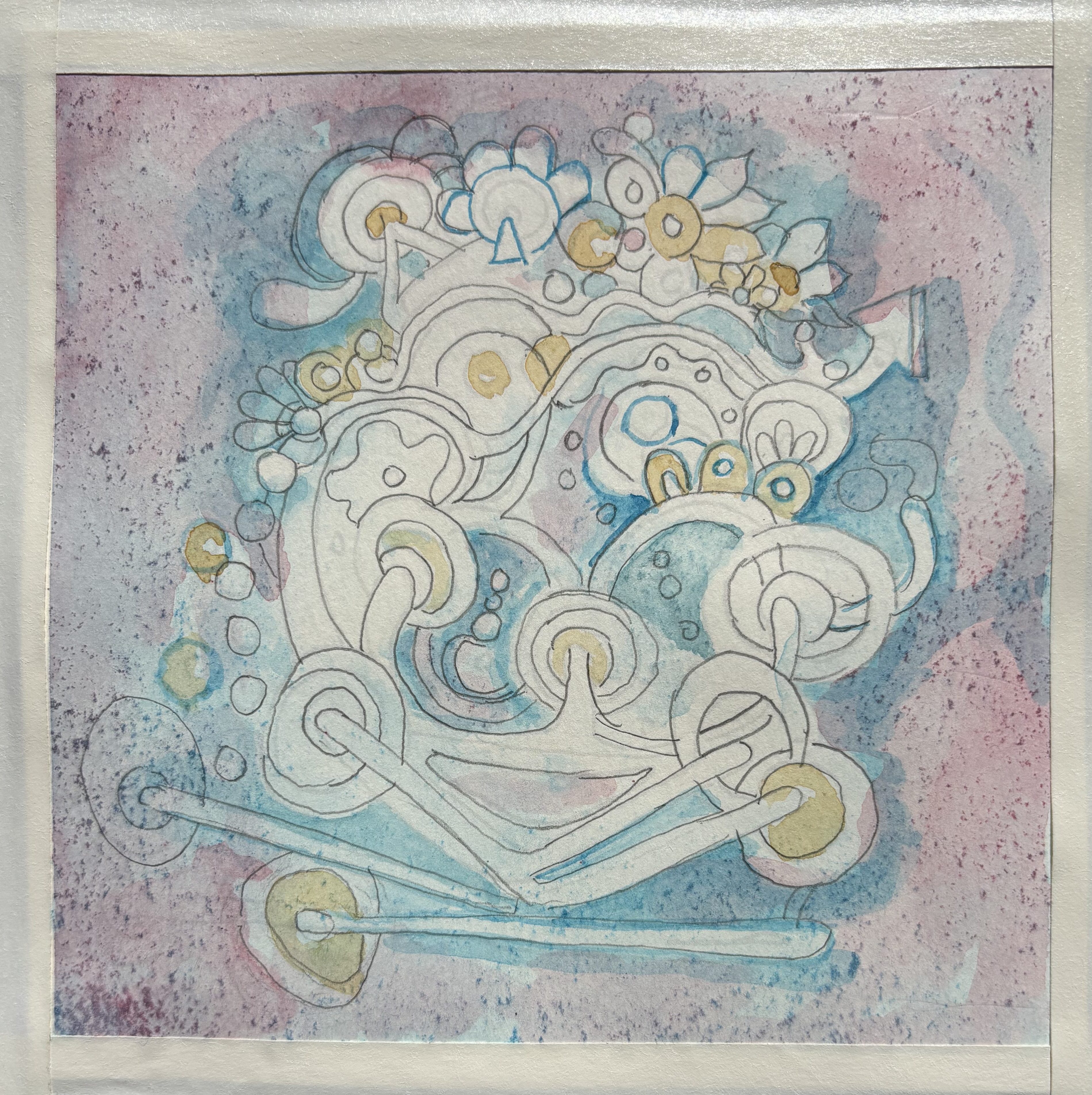
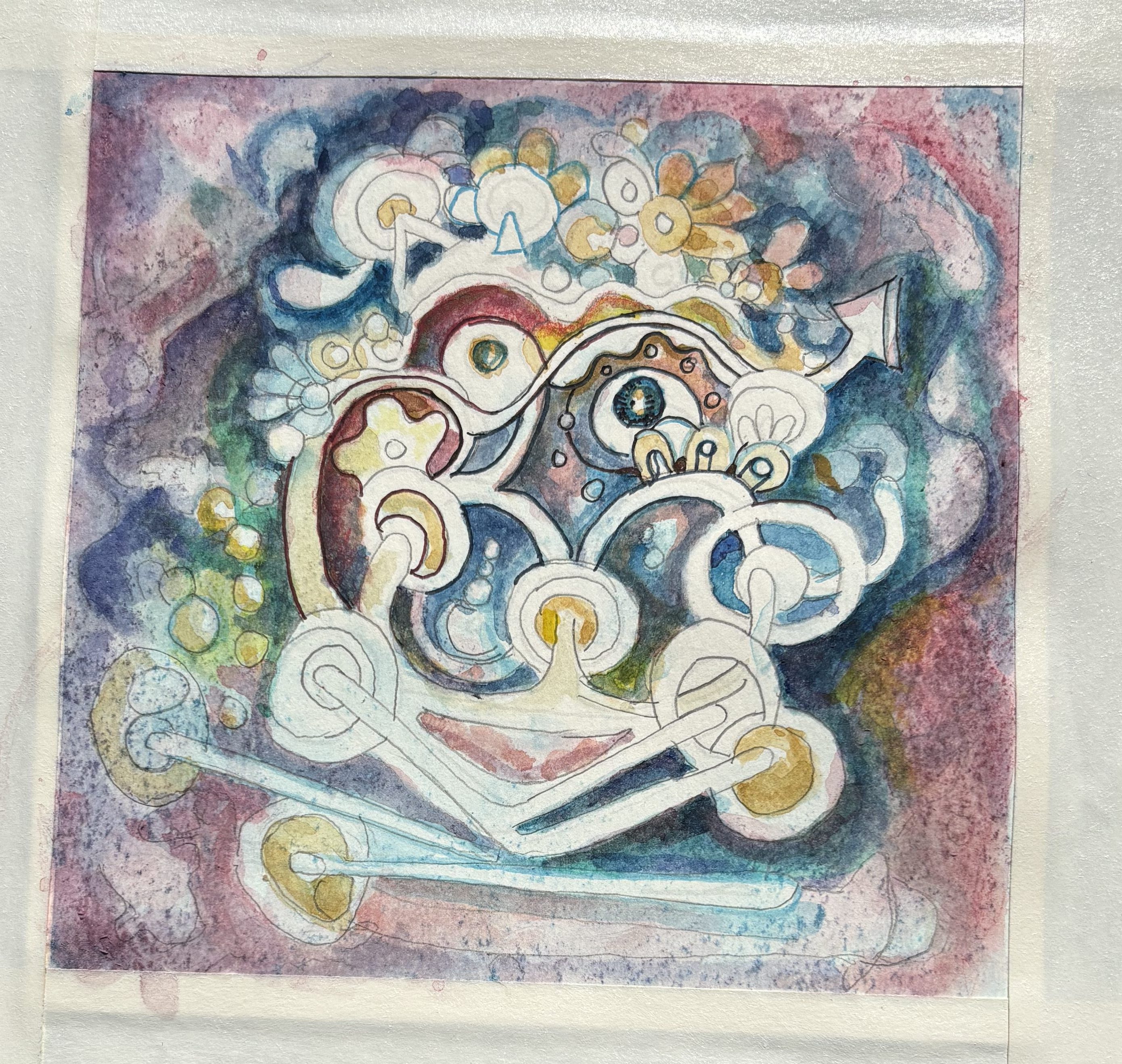
Three works in progress from the Small Works series, 2026. Pen and ink on paper.
Collective Z is a contemporary gallery and project space on Broome Street in New York, dedicated to artists working in states of transition, tension, and becoming.
I find myself reminiscing about the past more often these days.
I think about Christopher Street and the wonderful life that was lived there. I think about the friends I made, and the friends who became family, during one of the most intense periods in LGBTQ+ history—the AIDS epidemic.
So many of those friends are gone now.
But I still think about them. I remember them. And I think about the wonderful life I have had, and the life I am still having, and how much fun it would have been to share some of this life with them.
Maybe that has something to do with how Marsha P. came into being.
The original abstract drawing—the first stage of what became Marsha P.An early stage, as I explored tinting beneath the drawing and bringing areas back.A middle stage of the drawing, as the eyes, smile, and surrounding colors became more defined.Marsha P. — finished mixed-media drawing by Bill Hendricks, 2025.
The drawing did not begin as Marsha P. Johnson.
I know that.
It began as a very abstract sort of image. I was working with shapes and lines without any intention of making a portrait.
Then I began to see something.
First I saw the smile.
At this point, I was exploring how to tint underneath the drawing—putting color down and then bringing areas back.
As I worked, I began to see the eyes.
And all along there was a certain joy in the drawing that kept coming through.
I continued drawing, painting, changing things, covering things, uncovering things. The more I worked, the more something from my own history seemed to be coming forward.
My past became present.
Marsha was part of the world I remember.
I don’t mean that Marsha and I were close friends. We weren’t.
She was someone who passed through my life.
But she was a character on Christopher Street, just as I was a character on Christopher Street—working in a gallery among lots of other characters I loved dearly.
There was something about seeing her emerge from this drawing that gave me a way of becoming involved with that world again.
Not simply remembering it.
Participating in it.
For a little while, the distance between then and now became smaller.
The finished work became Marsha P.
For me, it carries more than the image of one person. It carries something of Christopher Street, of friendship, of loss, of survival, and of the extraordinary joy that existed alongside some very difficult years.
Maybe that is why the joy in the drawing matters so much to me.
The work later traveled to New York, where it was exhibited during Pride Month. The original Marsha P. is now available through Collective Z Gallery on Artsy.
But when I look at it, that isn’t what I think about first.
I think about the people.
I think about the life we lived.
Sometimes, while making a drawing, the past finds its way back into the room.
Currently at Collective Z
Collective Z is currently presenting Second Nature, bringing together painters Gwen Yip and Spencer Patrick. Their work considers the spaces New Yorkers move through—from the public world of subway platforms to the private interiors where people retreat.
Second Nature is on view through August 29, 2026, at Collective Z, 325 Broome Street, New York.
IMG_1712–What a Scandal-1980, Artist: Bill Hendricks (Shadowmason)
I made this drawing in 1980, just after I moved to New York City.
I was a kid from Minneapolis — recently out of college, a couple of years into working — and I had come to a quiet but unavoidable realization: staying where I was would mean living part of my life in a closet, or keeping parts of myself hidden. I decided to check out both Chicago and New York to see where I might land.
Chicago felt hard to me. New York felt open.
Within two weeks of arriving, I fell in love with the West Village. I went back to the Twin Cities only long enough to pack and was back in New York by Halloween. I found a roommate, found a job, lost a job, survived on unemployment — and like so many people before and after me, I found my community on Christopher Street.
This drawing came out of that moment.
I spent a lot of time at a small coffee shop called Kiss My Cookies. It was comfortable, cozy, and ahead of its time — cookies, brownies, coffee, small tables, and long conversations. I was there so often that Cy, the owner, offered me a job. I worked alongside Scott, Ralph, and Carlos, and two beat cops who stopped in regularly. Eventually, I wound up working at All State Art, a gallery just down the street.
Between the coffee shop, the gallery, and the block itself, Christopher Street became a cast of characters: Rollerena (sometimes called the Fairy Godmother), Marsha P. Johnson — often known as the saint of Christopher Street — along with actors, porn stars, artists, eccentrics, sweet misfits, a clown-college graduate, a lesbian manager, the joyful disaster of an owner’s brother, shopkeepers, cops, neighbors, and passersby. It was dysfunctional, funny, chaotic, kind, queer, deeply human.
This drawing isn’t meant to be a perfect architectural record. It’s an act of looking. The signs, the storefronts, the fire escapes, the rhythm of the street — all of it mattered to me. I was learning how to see a city not as a backdrop, but as a living system of people, labor, chance encounters, and survival.
When I look at it now, I sometimes think that stretch of Christopher Street was a sitcom waiting to be written. Not tragedy. Not trauma as the headline. Just life — community, chosen family, humor, tenderness, and endurance — long before anyone called it representation.
The paper has yellowed over time. I’ve chosen to leave it that way. It’s part of the object’s history, part of its truth.
These early artwork pieces from 2020/2021 became the first steps in my developing art practice. These pieces became the foundation for the themes I’m exploring today: spirit through art, creativity, identity, and transformation.
Looking back, I can see how curiosity, play, and questions about who we are and how we change began to take shape in this work. Those themes continue to guide me, both in the studio and in how I think about art’s role in my life.
“Serious play is the essence of creativity.”
— Paula Scher · TED-2008
I appreciate how play and spirit come together in these early pieces. You can see other works from that period in the gallery section.