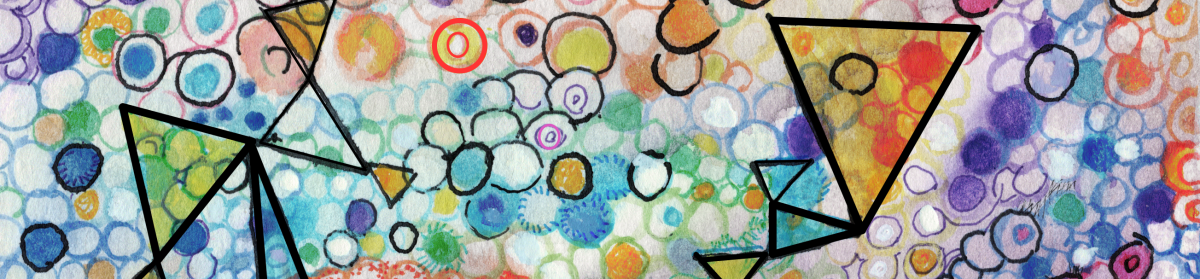

I’ve been thinking about that phrase.
A few years ago, while attending Friends General Conference, I took a Zentangle workshop. Part of my interest was practical. As a teacher, I was always looking for things I could bring back to my students. At the same time, I was doing some spiritual searching of my own.
When I retired, my intention was simple. I thought I would return to the work I had left behind years earlier when I completed my MFA. While teaching, my focus had been on technology, my students, and teaching itself. I assumed I would pick up where my thesis left off and continue from there.
I did return to my thesis and to its central ideas: how perception and physiology affect our vision of reality.
What I discovered, however, was that too much had changed. The media I was working with had changed. My interests had changed. Instead of continuing where I left off, I found myself asking some of the same questions I had wrestled with in graduate school.
What is my art about?
What am I trying to say?
And what medium is best suited to saying it?
At some point, I began to wonder if I was engaged in a kind of re-education.
Looking back at those early pieces now, I can see that many of them focused on value, texture, repetition, and mark-making. At the time, I didn’t really realize what I was exploring, but now they feel a bit like exercises in learning how to see and do again. To me, that’s my art re-education.
What I do know is that one thing kept leading to another.
A drawing would spark an idea for the next drawing, and little by little my curiosity carried me beyond the boundaries of Zentangle itself. Questions about line and pattern turned into questions about color, surface, and different ways to make marks.
Before I knew it, ink led to watercolor, watercolor led to gouache, gouache led to colored pencil, digital work, and eventually oil paint.
The recent exhibition at Collective Z feels like a milestone along that path. With the show entering its final week, I’ve found myself taking a breath and wondering what comes next.
And perhaps that’s the point: I’m still asking questions.
I’m not sure where the path leads from here, but I’m still eager to follow it.
“Art does not reproduce what we see. It makes us see.”
— Paul Klee

